The Sover approach
Room to lead themselves.
Sover applies high-fidelity Montessori within the Ministry of Education and Training’s early childhood curriculum framework, giving children room each day to do things themselves, ask questions and learn alongside friends. Explore how we put this into practice and the research behind it.

The prepared environment
Low shelves, child-sized furniture and neatly arranged materials let children choose, work and put things away for themselves.

A guide, not someone giving orders
Teachers observe each child and introduce materials when they are ready.

Mixed-age classrooms
Younger children observe and learn from older classmates. Older children build confidence by helping younger ones.
Toddler: 15–36 months; Primary: ages 3–6.

Uninterrupted work time
Children have uninterrupted time to concentrate on an activity they choose. In Primary, Montessori work time runs from 8:30 to 11:00.

Freedom within limits
Children choose their work, place and pace while learning to stay safe and respect friends and materials.
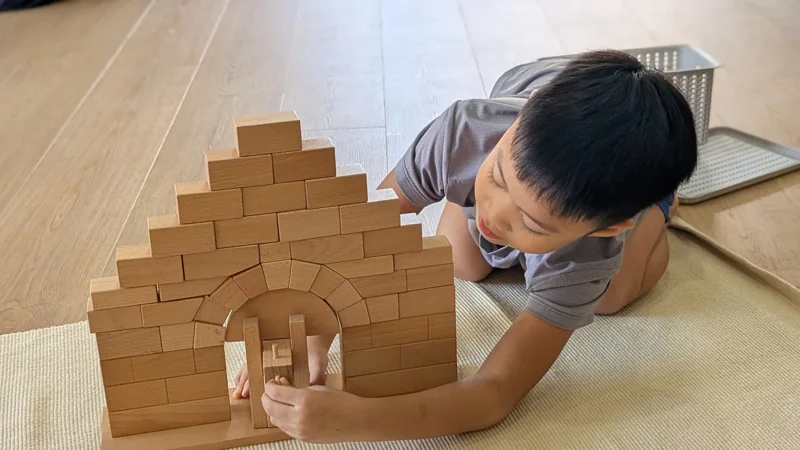
“I did it.”
I can do it myself.
Children take on real, manageable tasks. They try, meet difficulties and try again, with a teacher nearby who does not do it for them. Confidence grows through practice.
How Sover does this: At the lunch table.
Children help prepare and clear their place at meals, practise feeding themselves and choose more of the food they like. Furniture, shelves and tools are within reach.
Explore food at Sover ↗Insights from research
In a three-year study, more Montessori children returned to a difficult puzzle (65% versus 47%). A review of 32 studies also found a moderate difference in self-regulation.
Chose to retry a difficult puzzle · ages 4–5
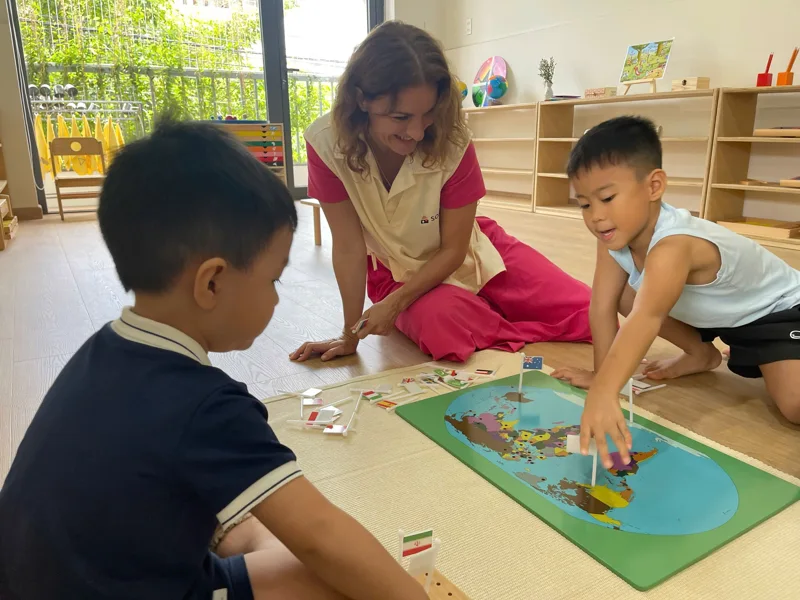
“I want to know more.”
I ask questions.
Objects, sounds and patterns make ideas tangible. Children compare, arrange and describe what they notice. Activities are introduced step by step, giving each child a manageable place to begin.
How Sover does this: A theme opens up discovery.
Each month has a main theme, with smaller weekly themes. Teachers introduce activities step by step; children choose where to begin and how deeply to explore.
Insights from research
In the same three-year study, Montessori children’s academic outcomes grew more quickly from the second year and they enjoyed learning more. The review found small to moderate differences in language and mathematics.
Lillard et al. (2017) ↗ Randolph et al. (2023) ↗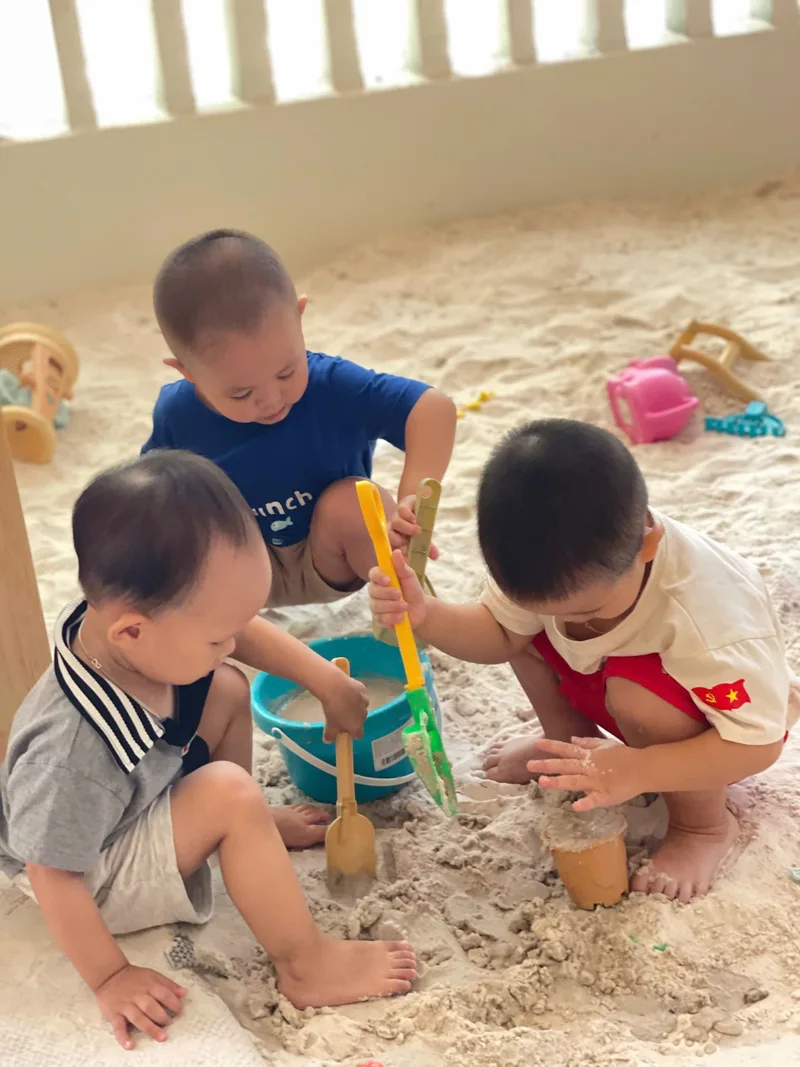
“Let’s do it together.”
I can work with friends.
Children practise saying what they need, listening, taking turns, asking for help and helping others. When they disagree, they first try to find a solution, with a teacher nearby when needed. Sometimes they invite a friend to join in.
How Sover does this: A moment in the classroom.
When two children both want the Pink Tower, the teacher sits at their eye level rather than deciding for them: “You can ask when your friend will be finished, or invite them to work together.” The children negotiate and decide to build the tower together.
Insights from research
Montessori children showed stronger understanding of others’ thoughts and feelings. The review found a small difference in social skills and a moderate difference in well-being at school.
Lillard et al. (2017) ↗ Randolph et al. (2023) ↗Questions parents often ask.
How does Sover’s approach differ from a conventional preschool?
Children choose activities that interest them in a prepared environment. Teachers observe and introduce activities step by step, rather than having the whole class do the same activity at a fixed time.
Does Sover use Montessori and follow the Ministry’s curriculum?
Sover applies Montessori methods: a prepared environment, hands-on materials and children choosing activities. The program also meets the framework of the Ministry of Education and Training’s early childhood curriculum.
Does Montessori guarantee better learning outcomes?
No approach can guarantee an outcome for every child. Studies report average differences across groups, but each child develops at their own pace. We follow your child’s progress rather than comparing them with others.
Is Sover suitable for an active or shy child?
There is room to move and room to concentrate, with each child progressing at their own pace. Visiting a class is the best way to see whether it fits your child.
What ages does Sover welcome, and does the research apply under age three?
Toddler is for children aged 15–36 months and Primary for ages 3–6. Most studies involve children aged 3–6, so for younger children we rely more on teachers’ observations and conversations with families.
What if my child cries or clings to me at first?
This is very common. Children begin with a parent nearby and one teacher supporting them, with support easing as they are ready.
Explore settling in ↗